BUILD THE SMALLEST USEFUL CONNECTION / FREE POCKET PRODUCT
Connected MVP Canvas
Turn a product promise into one useful tool and a testable release decision.

A small kit.
A useful finished result.
Use this canvas before building an MCP integration. It creates a product brief, not a running server. Start with one person, one recurring job and one action. The filled examples describe a fictional approved learning-resource finder; replace them with your own evidence.
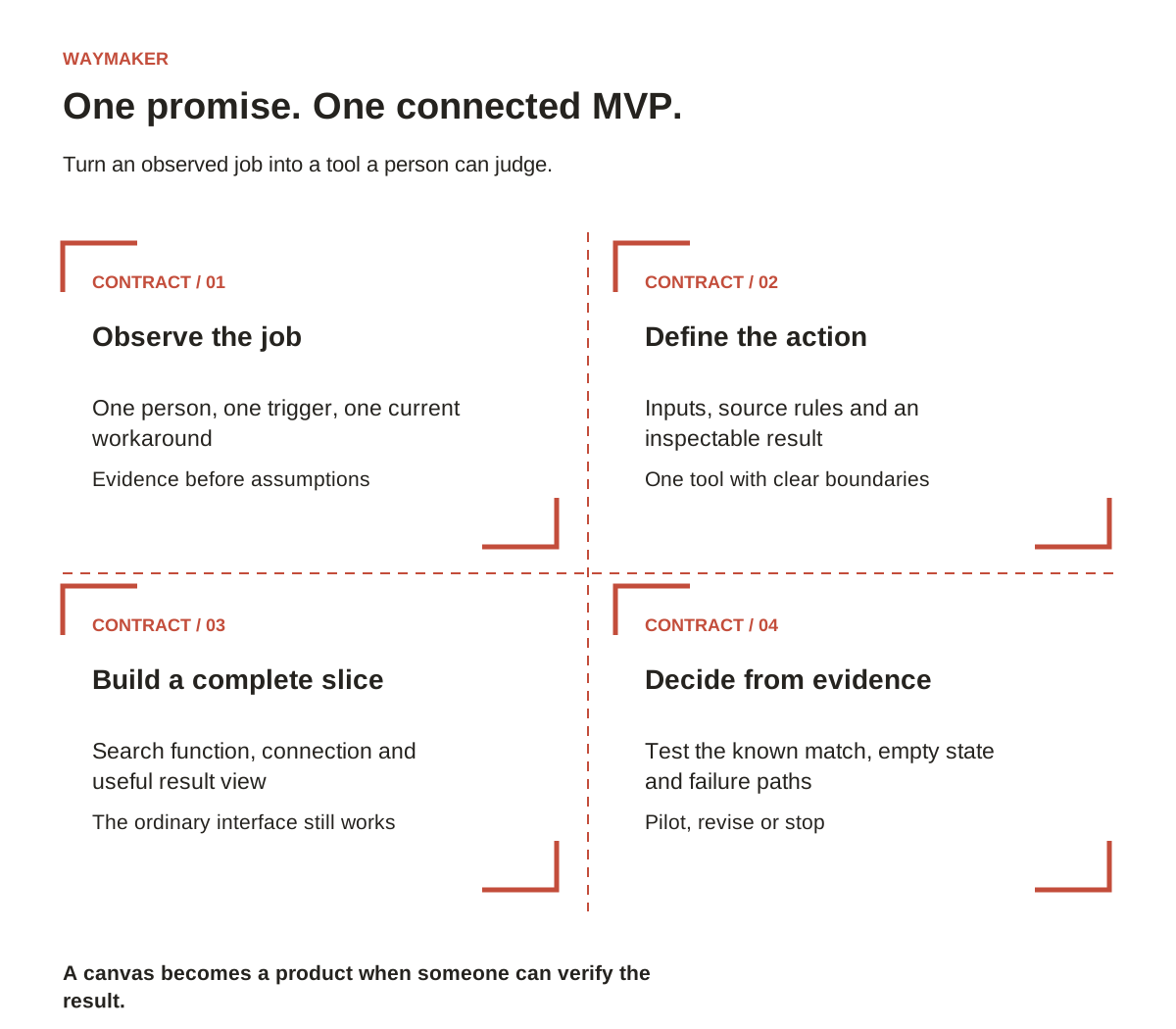
Observe one real task
Ask a prospective user to show the last time the job occurred. Record their workaround, source and decision. Replace broad claims with one concrete example.
Write the product promise
Complete the job story, identify the human decision and remove unrelated actions. A useful first slice should end with an inspectable result.
Specify the tool
Fill inputs, source rules, result fields and failure behavior. Use the editable contract in the kit to hand these decisions to a developer.
Challenge the promise
Run the acceptance matrix against a fictional fixture, then the real source. Capture actual output and evidence for each pass or failure.
Choose the next release
Use the decision memo to proceed with a bounded pilot, revise a specific weakness or stop. Assign maintenance and a review date before expanding.
YOUR WORKING CANVAS
Make it specific.
Write your own notes, or load the fictional example to see a completed version. Download your work before closing this page.
Your notes stay in this page's memory. Nothing is submitted, saved to an account or sent to an AI service. Closing or reloading the page clears your work.
Your export preview
EDITABLE COMPANIONS
Take the next step.
KEEP THE WHOLE KIT
Work at your pace.
The ZIP includes the PDF guide, the original graphic, this offline worksheet and all editable templates. Open index.html in a browser after extracting it.
Use the materials for your own project or client work. Check and adapt the examples; they are fictional demonstrations.
Download the complete kit