Manual work absorbs capacity.
Speak to the operations leader whose team spends time repeating administrative steps and handling the resulting queues.

B2B HEALTHCARE / PAYER WORKFLOW AUTOMATION
For HCIM, the story starts with the work that slows payer teams down: repetitive claims processing, provider updates, authorization administration and eligibility maintenance.
This campaign connects those problems to SymKey, a relevant next step and the evidence needed for a useful sales conversation.
Strategy, messaging, creative and content planning · Ashley Kays
THE CAMPAIGN LOGIC
Speak to the operations leader whose team spends time repeating administrative steps and handling the resulting queues.
Connect workflow automation to a practical operational benefit, then show how SymKey fits the work.
Match the query, ad and destination. Qualify the organization, use case and core environment before advancing the conversation.
The HCIM / AI Sales Engine engagement story documents positioning, conversion and sales follow-through. Its recorded outcomes describe the engagement; this page presents the campaign assets and forward-looking test plan.
AUDIENCE / PERSONAS / BUYING GROUP
Business role, organization type, workflow responsibility, and buying situation define the audience. Age, gender, ethnicity, and personal health are not used as proxies for a qualified buyer.
US is the proposed first-market test; confirm HCIM's actual sales coverage before launch. Start with health plans, third-party administrators and managed-care organizations; qualify the administrative environment and workflow before treating an inquiry as a sales opportunity.
Create sustainable operational capacity while protecting service quality and managing change.
A growing queue, capacity pressure, recurring rework, or a strategic mandate to improve operations.
Will this improve an important workflow, or create another tool for the team to manage?
Start with one material workflow, establish a baseline, and agree on the operating result and ownership before expanding.
A defined operational problem, a relevant core environment, an internal owner, and willingness to validate fit.
Keep routine work moving and preserve experienced staff time for complex cases.
The same types of work repeatedly return to the queue or require multiple handoffs.
Our exceptions are complicated; a generic automation pitch does not reflect how the work gets done.
Separate repeatable tasks from exceptions. Evaluate a specific process using your actual business rules.
The team can describe the workflow, its rules, volume, exceptions, and current owner.
Understand environment compatibility, access, operational control, and ongoing support before approving a change.
Operations requests automation or a vendor comparison requires a technical review.
How will this work in our environment, and who owns maintenance, access, and failure handling?
Make workflow fit, access, action visibility, change handling, and accountability explicit in the evaluation.
The core environment and technical constraints can be reviewed with an authorized stakeholder.
Reduce repeated administrative effort while keeping ownership and exceptions clear.
Recurring updates, inconsistent handoffs, a manual queue, or time spent checking the same work repeatedly.
Our process varies by business rule, source, and exception. What happens when a case does not fit?
Document the common path, define the boundary, and identify the human handoff before automating repeatable steps.
A repeatable administrative process exists with an owner who can define routine work and exceptions.
Separate plausible operating value from unsupported savings and build a decision-ready business case.
Budget planning, capacity requests, vendor evaluation, or expansion of a successful initial workflow.
Time saved is not automatically cash saved. How will we know whether this is worth expanding?
Measure the actual operational change, the capacity it releases, the cost to operate, and what the organization can do with that capacity.
The team can agree on costs, measurable outcomes, and a realistic evaluation period.
GOOGLE SEARCH / RESPONSIVE SEARCH ADS
Each set contains 15 headlines and four descriptions. Headlines stay within 30 characters; descriptions stay within 90. Open a set to review or copy every asset.
Headlines and descriptions must make sense in different combinations. Review final assets, destinations and tracking before activation; pin only when a required message must appear consistently.
Reduce repetitive claims administration so the team can focus on exceptions that need attention.
Buyer: Claims leaders and payer operations teams evaluating help with repeatable administrative claims work.
Display path: /claims/automation
Your claims specialists have more valuable work than repeating the same administrative steps. Explore which routine workflows SymKey can support in your existing environment.
Conversion: A qualified inquiry requesting a discussion of a specific claims workflow.
Compare the backlog/problem message with the capacity/benefit message while holding audience, destination, and offer steady. Review actual served combinations; an RSA can combine assets in different orders.
Make repeatable provider administration more manageable without treating exceptions as routine.
Buyer: Provider data, network operations, and payer administration leaders responsible for routine provider maintenance.
Display path: /provider/automation
When routine provider work keeps returning to the queue, more effort alone is not a process improvement. Explore how defined business rules can support repeatable administration.
Conversion: A qualified inquiry identifying a provider administration workflow and its owner.
Test the recurring-update problem against the team-capacity benefit. Separate provider administration queries from consumer searches for a healthcare provider.
Support repeatable authorization administration while preserving the appropriate human review.
Buyer: Authorization operations and payer leaders evaluating repetitive administrative workflow support.
Display path: /authorizations/workflows
Free up attention for the work that needs it. Explore defined administrative tasks around authorizations, with clear boundaries for clinical judgment and exception handling.
Conversion: A qualified discussion of administrative authorization workflow fit.
Keep administrative workflow language explicit. Exclude patient status, denial appeal, and treatment-approval searches when they do not reflect a payer buying a workflow solution.
Reduce repeated administrative effort in well-defined eligibility workflows.
Buyer: Membership, enrollment, and eligibility operations leaders at payer organizations.
Display path: /eligibility/automation
Routine eligibility work should not consume all of your team's attention. Start with a clear workflow, defined rules, and a plan for the cases that need human review.
Conversion: A qualified inquiry from a payer team with an identifiable eligibility workflow.
Distinguish payer administration from consumer coverage checks and provider billing eligibility tools. Evaluate search terms before broadening reach.
RESEARCH / BUYER INTENT / NEGATIVE PLANNING
Research-led seed plan. Search volume, auction CPC, competitive density, and forecast reach have not been measured in a live keyword-planning account.
Start with tightly grouped exact and phrase keywords. Expand only after search-term quality, conversion tracking, and qualified inquiry feedback are reliable. The phrases below are seeds, not a finalized account import.
High commercial intent
Separate payer administration from personal insurance claims and provider revenue-cycle software.
High commercial intent with ambiguity to inspect
Watch consumer provider searches, clinical services, and directories; do not exclude useful provider-data queries too broadly.
Commercial intent; distinguish administrative and clinical needs
Exclude patient approval-status queries and unsupported clinical-decision needs rather than claiming medical decision automation.
Commercial intent with payer-fit qualification
Provider billing verification and consumer benefit eligibility can be different buying needs; inspect the actual query before excluding.
Category evaluation
Use only if the budget can support a separate category ad group without starving module-level learning.
Navigational and product evaluation
Report brand separately from non-brand acquisition. Identify existing-customer support and training intent before attributing leads to new demand.
Early research; primarily organic thought leadership
Use for educational content first. Broad informational demand can consume a small acquisition test without producing near-term buying conversations.
Potential active evaluation
Next step: Align the ad and destination to the named workflow; qualify fit in the inquiry.
Possible account-level interest, not a confirmed purchase decision
Next step: Offer a joint operations and IT discussion, using consented first-party data and the agreed sales process.
Stronger buying evidence than an anonymous click
Next step: Record the use case and qualification outcome in CRM.
Topic interest only
Next step: Nurture with relevant insight; do not count the action as a sales-qualified lead.
Protect the acquisition budget by excluding demonstrated irrelevant intent at the narrowest useful scope. Review the search term and the full buyer context before adding a negative.
Scope: Shared non-recruiting acquisition campaigns
Seeds: jobs · careers · salary · resume · internship · interview questions
Match: Phrase or exact after reviewing query context
Someone looking for employment is not shopping for payer workflow software.
Do not apply this list to any separate recruiting campaign.
Scope: Commercial software acquisition campaigns
Seeds: homework · exam answers · assignment help · course syllabus
Match: Phrase or exact
Exclude clearly academic assistance searches that do not indicate a buying organization.
Do not blanket-exclude training, guide, certification, or research; a buyer may need enablement or evaluation information.
Scope: Claims ad groups
Seeds: car accident claim · auto insurance claim · home insurance claim · small claims court · flight compensation
Match: Phrase or exact
These searches describe a different market or personal claim process.
Avoid a broad negative such as insurance, claims, or claim status without context.
Scope: Authorization ad groups
Seeds: check my prior authorization · appeal my denial · prior authorization phone number
Match: Exact or tightly scoped phrase
A person seeking help with their own authorization is not evaluating a payer operations platform.
Do not exclude prior authorization as a blanket phrase; some operations buyers use it when describing administrative needs.
Scope: Eligibility ad groups
Seeds: am i eligible for medicaid · apply for food stamps · check my benefits · unemployment eligibility
Match: Exact or tightly scoped phrase
These queries seek personal benefit eligibility rather than administrative workflow automation.
Do not blanket-exclude Medicaid, Medicare, enrollment, or member; these can be legitimate payer contexts.
Scope: Provider ad groups
Seeds: doctor near me · dentist near me · find a primary care doctor
Match: Phrase or exact
Consumer provider discovery is different from provider-data administration.
Do not blanket-exclude provider, directory, or network; those words can signal legitimate operations needs.
Scope: New-customer non-brand acquisition only
Seeds: symkey login · hcim support number · symkey password reset
Match: Exact
Keep customer-support activity distinct from new-customer acquisition.
Retain a suitable organic or support route and do not apply to dedicated customer education campaigns.
Do not automatically exclude: free, comparison, pricing, cost, review, training, Medicaid, Medicare, provider, claims, prior authorization.
Review search terms on each business day during the first week, then at least twice weekly during the test. Record the query, reason, scope, match choice, and reviewer in a change log.
Positive and negative matching do not behave identically. Check current platform behavior and explicitly review variants before assuming a negative covers every related query.
LINKEDIN / SINGLE-IMAGE ADS
Three evergreen creative directions for the payer buying group. Download the JPGs and pair each with its corresponding ad copy and module destination.
Problem-aware to solution-aware
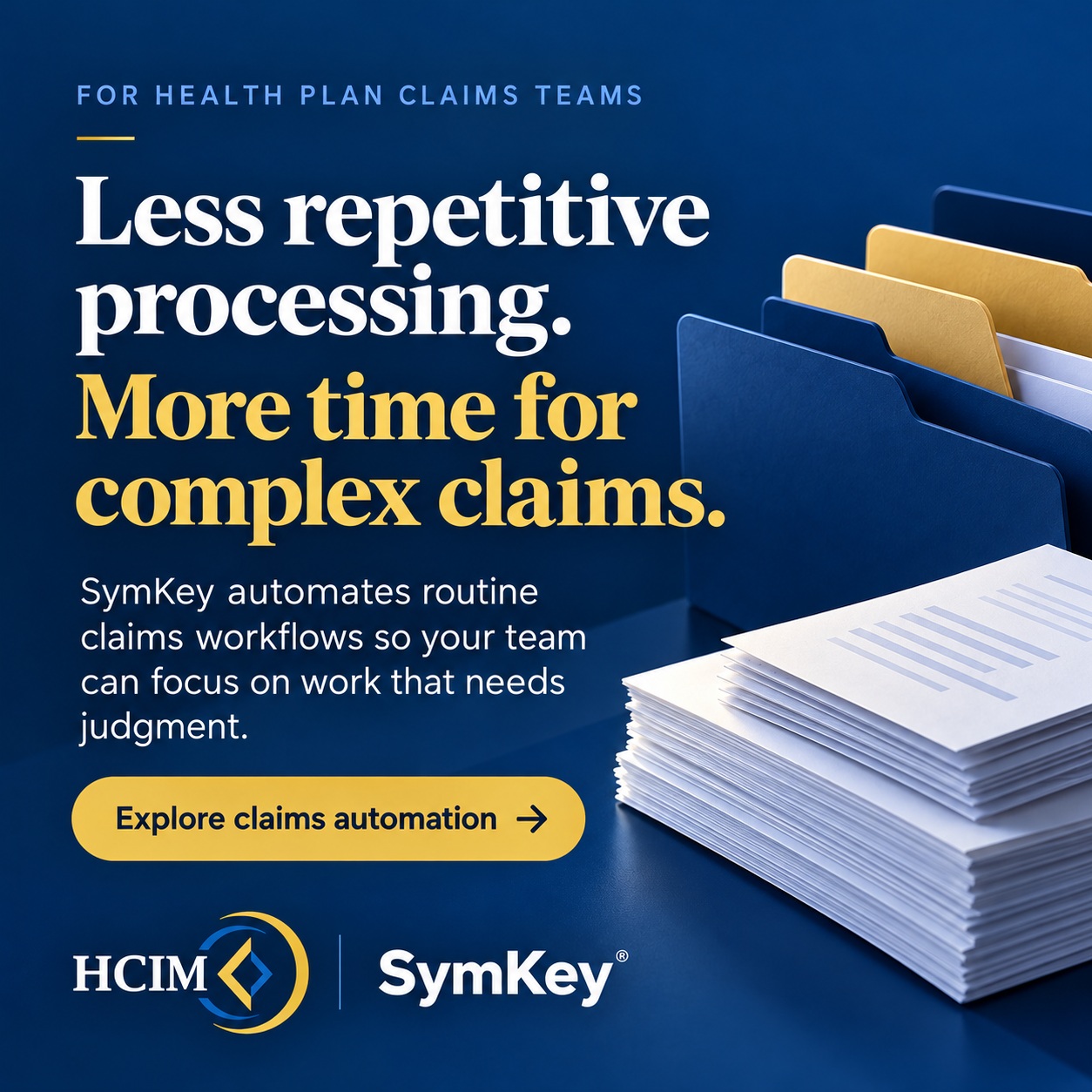
Claims work piling up? SymKey helps automate repeatable administration so your team can focus on exceptions. Explore the Claims module.
HEADLINELearn more
Audience: US payer claims and operations leaders: Director of Claims, Claims Operations Manager, VP Operations, and equivalent responsibilities at health plans and third-party administrators.
Creative decision: Connect repetitive administrative work to constrained claims-team capacity, then offer a specific module and workflow discussion.
Test: Compare a backlog/problem headline with a capacity/benefit headline in the same claims audience and destination. Evaluate qualified workflow inquiries as well as click cost.
Open the destination ↗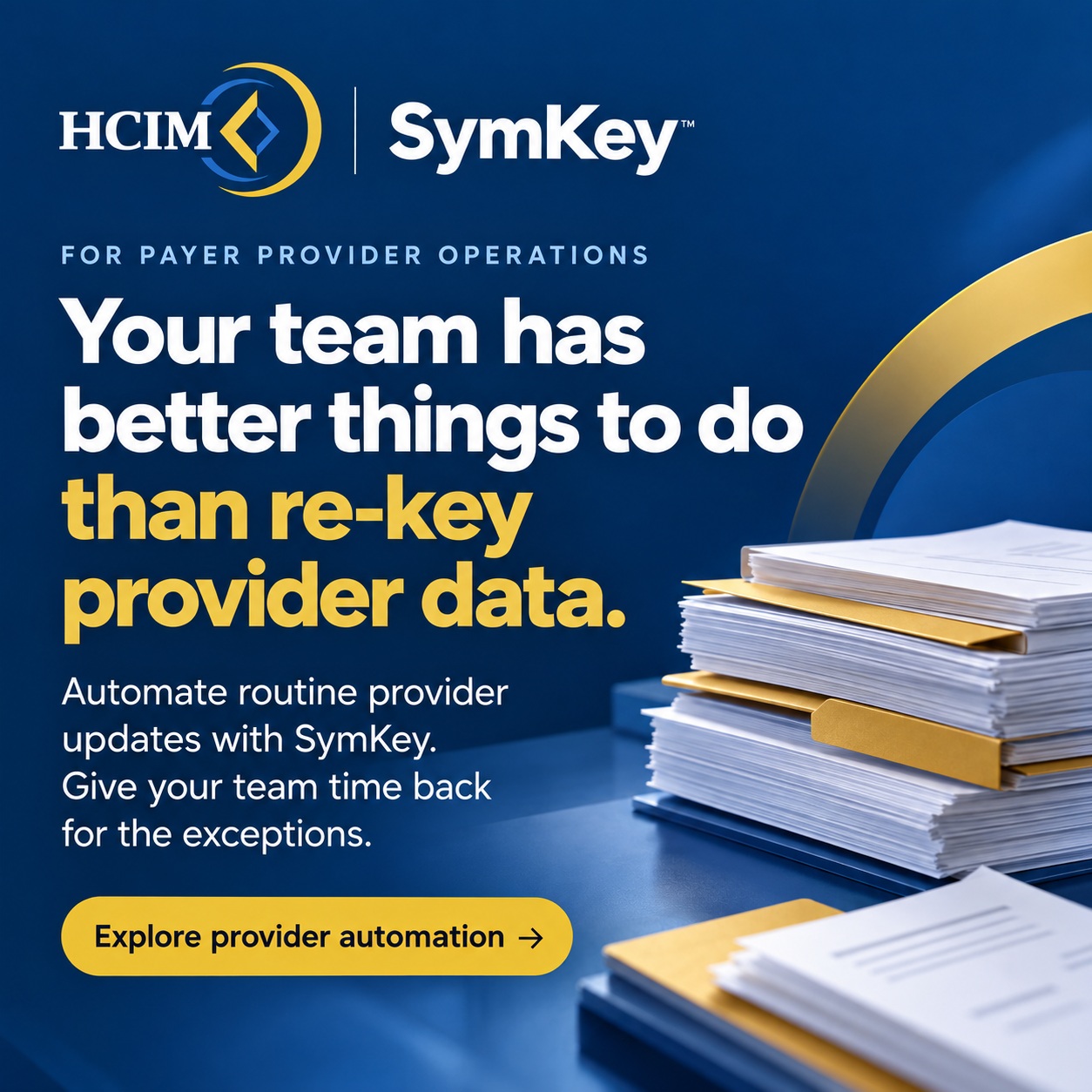
Problem-aware to product evaluation
Provider updates keep coming. Explore SymKey for repeatable administration, using your business rules in your existing core system.
HEADLINELearn more
Audience: US payer provider-data and network-operations leaders, supported by operations and enterprise-applications stakeholders responsible for provider administration.
Creative decision: Address recurring provider administration with a defined workflow, business rules, and a relevant product conversation.
Test: Compare recurring-work and team-capacity messages within the same qualified provider-operations audience. Check inquiry roles and workflow needs before calling a message successful.
Open the destination ↗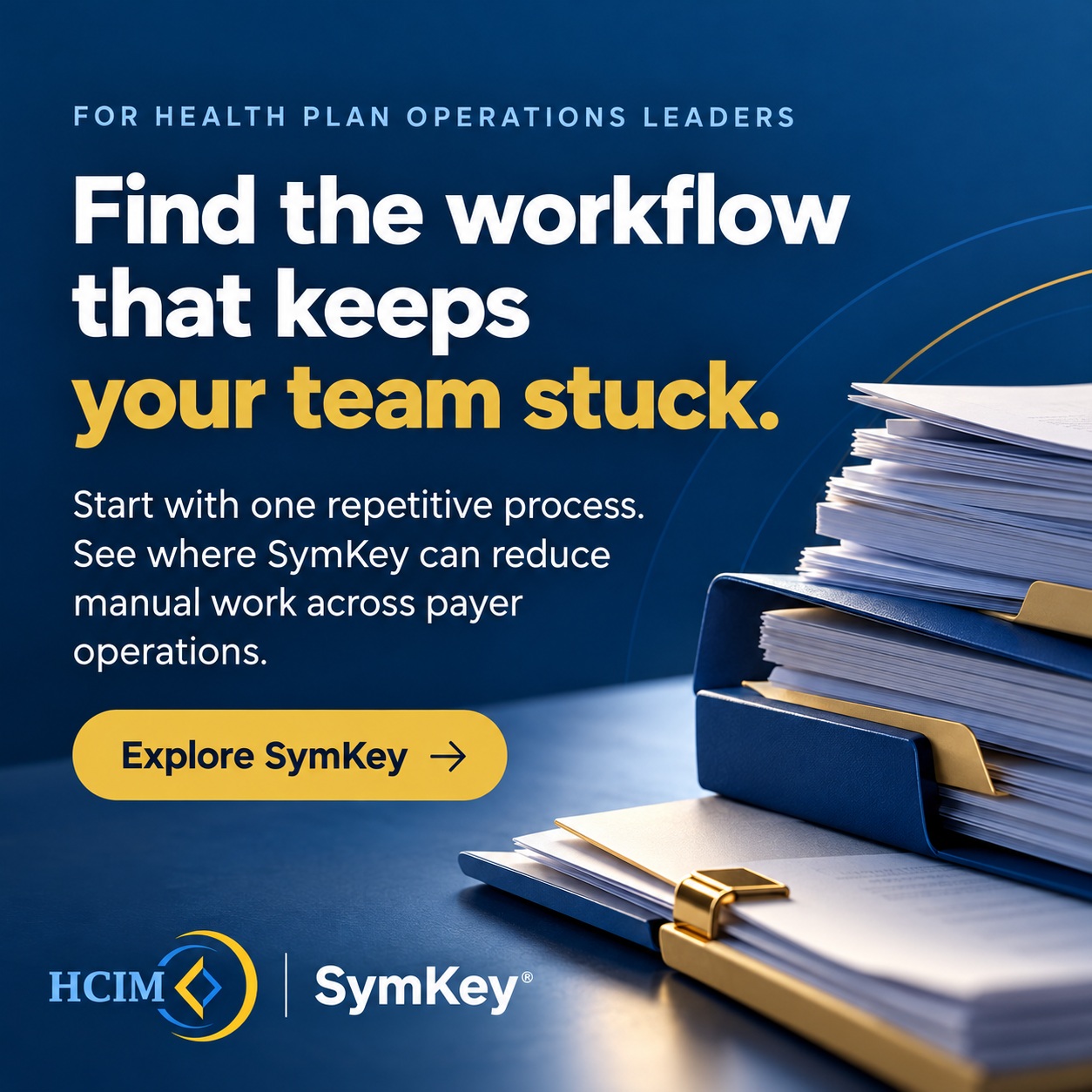
Solution-aware and evaluation
Claims. Provider data. Authorizations. Eligibility. Start with one repeatable workflow and see where SymKey fits your existing core system.
HEADLINELearn more
Audience: US payer operations and IT leaders jointly evaluating workflow automation; use relevant company lists where available, with size and role criteria validated against HCIM's sales fit.
Creative decision: Reduce the perceived complexity of getting started by focusing on a bounded workflow with explicit rules and exceptions.
Test: Test a workflow-focused headline against a capacity-focused headline. Keep the offer consistent: explore the module and discuss an actual operational workflow.
Open the destination ↗Introductory text is kept within 150 characters and headlines within 70 to reduce truncation. Images use LinkedIn’s supported square format; check the placement preview before publishing.
THE THOUGHT-LEADERSHIP PROGRAM
A workflow-first point of view, five editorial pillars, twelve finished posts, twenty-four additional post briefs and a practical production and measurement system.
Explore the complete content strategy ↗WEEK 01 / A USEFUL POINT OF VIEW
“The best first automation conversation starts with the work.”
Who owns it? What starts it? Which steps follow defined rules? Where does someone need to make a judgment?
Read the twelve posts ↗CLIENT ASSETS / APG SPRING CONFERENCE 2026
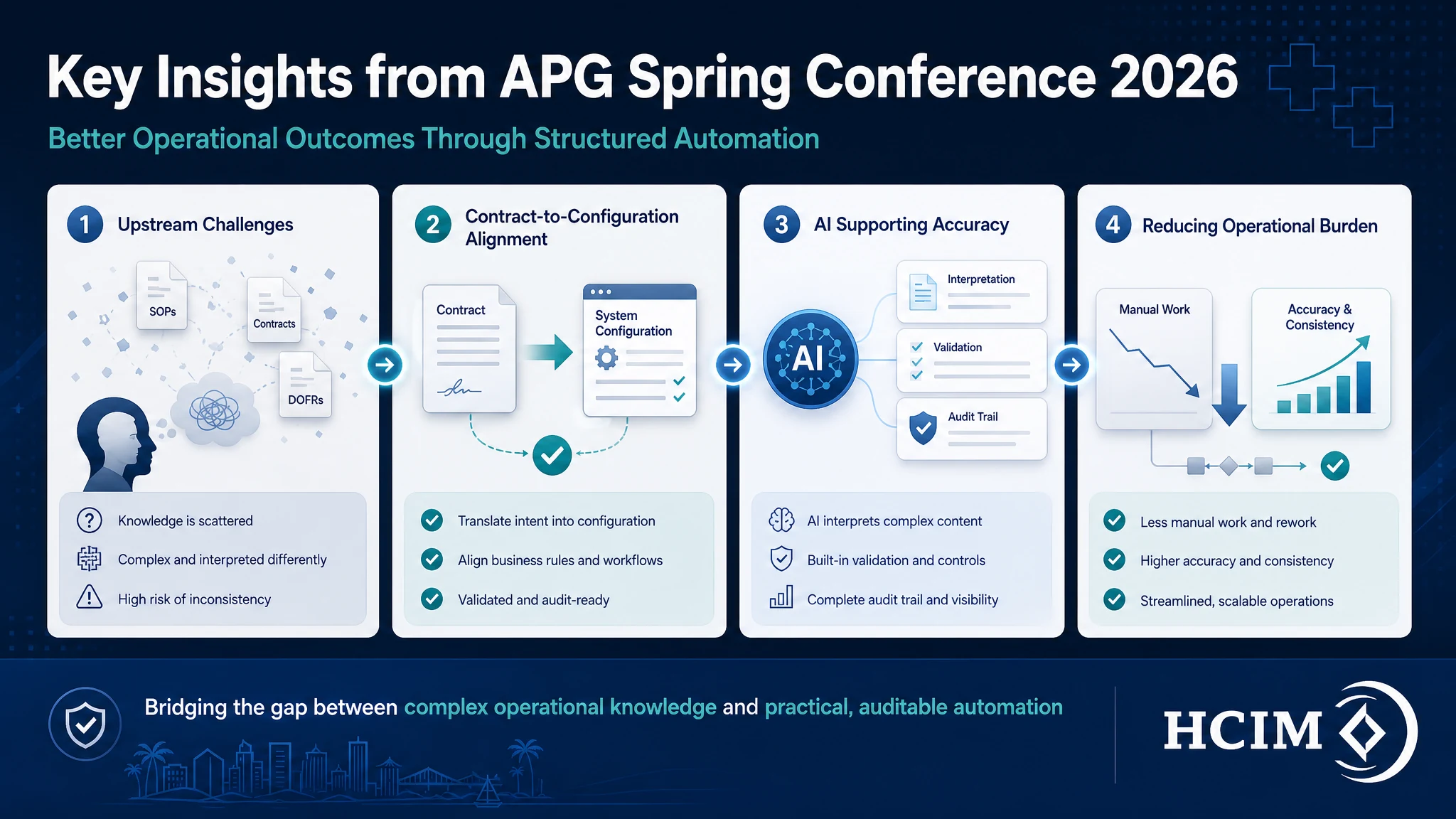
Selected conference campaign assets: a workflow-focused invitation, a warmer personal connection and an email follow-up visual. These are presented as past event work.


AD SPEND / TEST DESIGN / MEASUREMENT
Proposed 30-day media test — planning allocation, not historical spend. Learn which payer workflows and messages attract relevant buying conversations. This is a bounded learning budget, not a guaranteed minimum for impact or a promised revenue result.
Google Search
$4,000Capture explicit workflow and software evaluation intent.
Reach the operations and technical buying group with a clear, useful point of view.
Total: $6,000 in media over 30 days. Excludes creative production, landing-page development, tracking implementation, agency or management fees, sales follow-up, taxes and any applicable platform charges beyond the media allocation. Actual spend and HCIM ad-attributed ROAS are not reported in this campaign plan.
Illustrative arithmetic only — assumptions, not a forecast or HCIM results.
None of these CPCs or conversion rates has been validated in an HCIM advertising account. Replace the assumptions with observed data; different inputs can produce substantially different outcomes. Click-based arithmetic is simplified and does not replace session-based analytics.
If a mature campaign cohort eventually generated $18,000 of attributable recognized revenue from $6,000 in media spend, media ROAS would be 3.0×. This is an arithmetic example only, not an HCIM result or revenue expectation. Profitability requires the full cost picture.
Specific workflow problems and clear administrative benefits will produce a higher share of qualified inquiries than broad automation language.
Primary outcome: Unique qualified inquiries and their cost, with held evaluation meetings as a downstream quality check.
Thirty days may reveal message and demand quality but can be too short to establish revenue ROAS for a payer software sale. Search inventory and target-account reach may also limit delivery.
The media cost reported by the advertising platform for the defined period.
Keep separate from creative, implementation, software, and agency costs.Ad clicks ÷ ad impressions × 100.
Diagnose whether the message earns attention in its audience and placement. Do not treat high CTR as evidence of buyer fit.Ad spend ÷ ad clicks.
Understand the price of traffic while checking the search-term and audience mix.Valid inquiries ÷ attributable landing sessions × 100, using a consistent measurement source.
Assess the offer and page experience; deduplicate spam and repeated submissions.An inquiry from a relevant organization and role with a concrete workflow need that meets agreed sales-fit criteria.
Record the workflow, buying role, fit, owner, and next step in CRM. A form submission is not automatically qualified.Ad spend ÷ unique attributable qualified inquiries.
Compare campaigns on useful demand rather than raw lead count.An attended meeting in which the relevant stakeholders discuss workflow fit and a real next step.
Separate booked meetings from held meetings and record the reason for no-shows or disqualification.The value of opportunities meeting an agreed sales-stage definition and linked to the campaign under a documented attribution rule.
Report stage, age, and source alongside value. Pipeline is not booked revenue or ROAS.Attributed recognized revenue ÷ ad spend, using a stated attribution model, window, and revenue basis.
Report only when revenue can be reliably connected and the sales cycle has had time to mature. Do not present projected lifetime value as realized revenue.Evaluate gross profit and total acquisition cost in addition to media-only ROAS.
A high media ROAS can still hide an unprofitable acquisition once delivery, sales, creative, and service costs are included.Documented engagement with a resource by a contact or account that later advances, subject to consent and tracking limits.
Treat the content as an observed touchpoint, not proof that it caused the opportunity.Spend pacing, tracking health, broken destinations, irrelevant queries, spam, and urgent lead routing.
Search-term quality, audience fit, creative response, inquiries, frequency, and evidence of landing-page friction.
Qualification, held meetings, objections, workflow needs, and follow-up quality.
Opportunity progression, attributable revenue where available, costs, and the decision to continue, adjust, or expand.
A defensible view of relevant demand, message response, qualification quality, and the next test. No lead count, closed revenue, or ROAS is guaranteed.
PRODUCT & FORMAT REFERENCES / REVIEWED OCTOBER 2026
STRATEGY THROUGH EXECUTION