In this article
The most useful question about AI agents is becoming more specific: which part of your work can you give an agent responsibility for, and what would prove it did a good job?
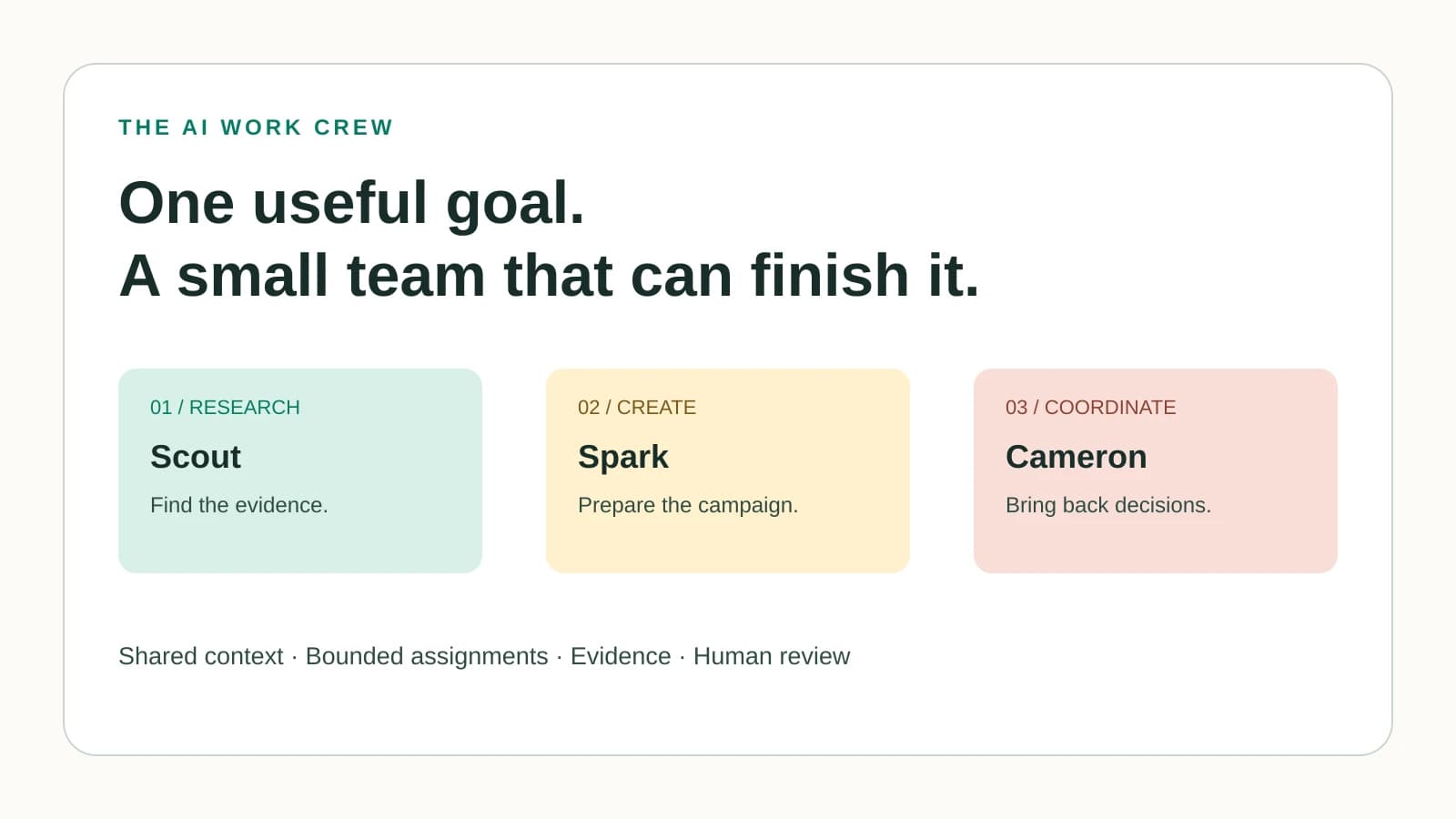
A lead researcher could bring back five relevant businesses with evidence of fit. A marketing agent could turn one approved offer into a landing page and a follow-up sequence. A coordinating agent could keep those assignments moving and bring you the decisions that need your attention.
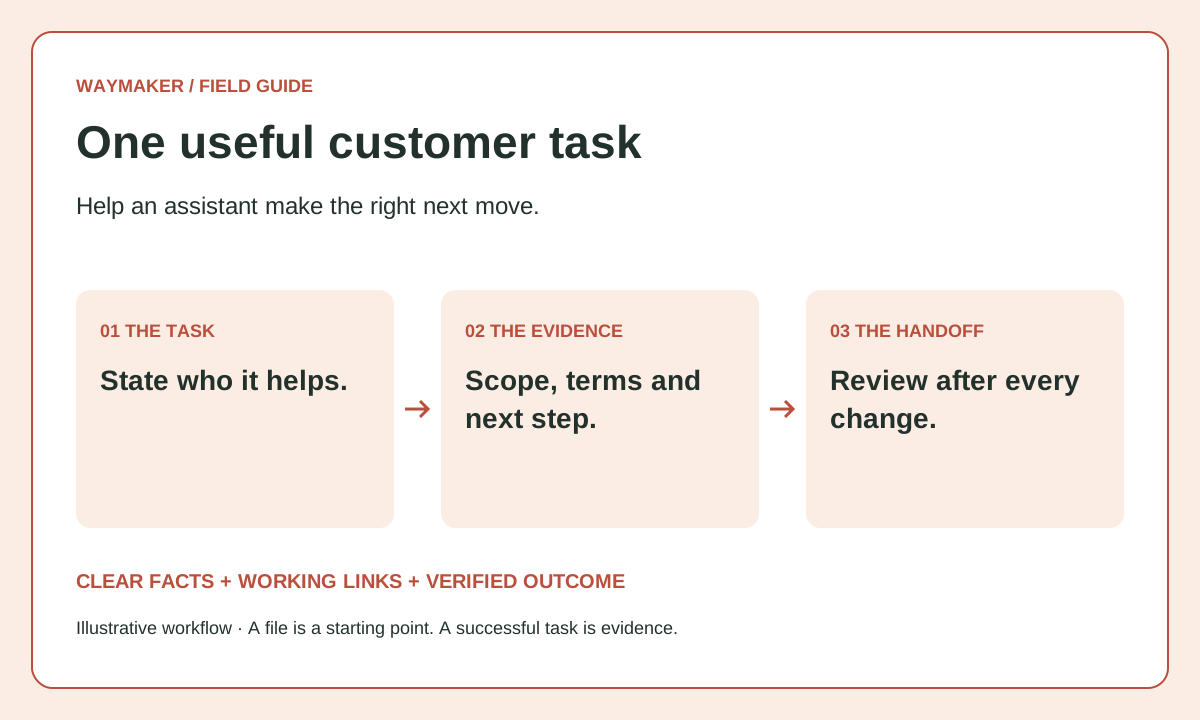
That is the opportunity we see for entrepreneurs, small business owners, and product teams: give AI a clear job, connect it to the right information, and judge it by the quality of the work it completes.
Rich Holmes's November 12 article, Personal Agent Systems Explained, offers a useful starting point. His examples describe leaders organizing their work around personal agents. We take that idea in a practical direction here: how to design your own system, where a small team of agents helps, and how to tell whether it creates value.
Read the animation steps
- You define the goal and limits.
- Cameron assigns a bounded task.
- Specialists return evidence and a draft.
- Cameron packages the proposed next action.
- You review and approve the defined action.
- Gauge records the result and feeds it back into the next brief.
What makes this a system?
A personal agent system combines six things: a goal, relevant context, tools, a trigger, operating boundaries, and a record of results.
Consider the difference between asking for marketing ideas and assigning responsibility for preparing next week's workshop campaign. The second assignment needs current event details, a defined audience, approved claims, access to the draft assets, and a clear finish line. It also needs a way to distinguish a draft from a published campaign.
A name helps you remember who owns the work. The surrounding process makes that ownership useful.
For our purposes, an agent is a tool-using worker; a subagent is a worker delegated a bounded part of a larger task; and a swarm is a coordinated group working on the same objective. These are useful working definitions, not standardized product categories. A durable bot can keep a role across projects. A temporary subagent can finish one research assignment and stop.
Five patterns worth borrowing
Holmes describes Brian Armstrong organizing work through lead agents and one review queue; Akshay Kothari keeping portable context in Notion; Karri Saarinen using a product operations bot; and Addy Osmani using adversarial agents to challenge decisions. These leadership examples are reported by Holmes. We draw four practical patterns from them and add a fifth from our review of a commercial bot-building experiment.
1. Bring decisions into one queue. Let specialists do the preparation, then ask a coordinator to return a recommendation, its evidence, the proposed action, and the decision required. For a small business, this might be five prospects worth approaching, one campaign ready for review, and a checkout issue that needs fixing.
2. Give every worker a reliable context source. Keep the offer, audience, approved prices, brand voice, current projects, and decision history in one maintained place. Give each agent only the parts it needs. Record when facts were checked and who can change them. Shared context is useful only when it is current and access is deliberate.
3. Turn feedback into work that can be finished. A product operations agent can organize a vague complaint into a reproducible problem, an acceptance criterion, and a task. The same idea works in marketing: “People are not booking” becomes an investigation of the form, offer, traffic source, and follow-up. Linear's published Grok Bot guide supports this pattern of investigation, planning, and coordination with coding agents. [1]
4. Give someone the job of disagreeing. Ask an independent reviewer to identify weak evidence, customer objections, and reasons a recommendation could fail. Have the reviewer form its assessment before reading the coordinator's preferred answer. Agreement between agents is not proof; a claim still needs a source or a test.
5. Run a bounded commercial experiment. Codie Sanchez's bot-building video is useful because it exposes the gap between getting a bot to perform work and proving that the work pays. Our companion playbook includes a timestamped assessment. The design lesson is to define success before a run and keep cash, pipeline estimates, and time savings in separate columns. [2]
Can one agent create other agents?
Yes, on systems that support it. Three different capabilities are often bundled into that sentence.
An agent may draft another role's instructions, launch a temporary worker, or create a persistent bot with its own ongoing responsibilities. Those are different operations. Writing “create ten agents” into an ordinary conversation does not supply missing tools, permissions, memory, or scheduling.
Grok Bot documents that existing bots can create focused bots and that a primary bot can coordinate them. OpenAI documents dots delegating work to parallel background agents. Claude Code documents specialist subagents, including nested delegation. These are meaningful capabilities, but they do not make every platform's setup interchangeable. [3][4][5]
For an initial project, we would use one lead and two or three specialists. Separate independent research or review work. Keep dependent steps in order. A copywriter can explore headlines while a researcher gathers audience evidence, but the final campaign needs the approved offer before it can be completed.
Every delegated assignment should include a deliverable, allowed tools, source requirements, a budget, a deadline, and a stopping condition. The coordinator should wait for the evidence it needs, resolve conflicts, and return one useful result. Adding workers should reduce the human's coordination burden.
Which platform fits which job?
This is a capability comparison of relevant platforms, not a measured popularity ranking. Documentation was checked on November 15, 2026; account access and integrations vary.
Open the detailed reference table
| Platform | Documented capability | Where we would start |
|---|---|---|
| Grok Bot | Persistent bots, a coordinating primary bot, connected tools, and routines. | A named crew with repeat responsibilities. Check actual app connections before promising an end-to-end workflow. [3][6] |
| OpenAI dots + ChatGPT Work/Codex | Dots can coordinate ongoing work and delegate background tasks; Work/Codex support explicit subagent requests. | A coordinator that returns research, files, and decisions across projects. Persistent responsibilities and temporary subagents should be tracked separately. [4][7] |
| Claude Duet | A proactive agent that works in the background using connected apps and its own virtual machine. | Briefings, follow-through, and preparation. The reviewed announcement does not establish a user-controlled persistent bot factory. [8] |
| Claude Code | Configurable subagents and nested delegation; agent teams are a separate experimental capability. | Building or testing workflows, researching in parallel, and reviewing implementation. Ordinary Claude conversation is not evidence that these orchestration controls are available there. [5][9] |
| Notion Agents | Custom agents for recurring work using workspace knowledge and connected tools. | Keeping the work queue, context, and recurring updates close to the team’s records. [10] |
| Meta Muse | Background tasks across the web and connected apps with permission controls. | Personal coordination and research. The reviewed product page does not establish configurable multi-agent spawning. [11] |
For most people, the best first platform is the one already connected to the information they need. Moving a workflow to a different model is less useful than giving the current agent a clear offer, trustworthy records, and a testable job.
Our version: the AI Work Crew
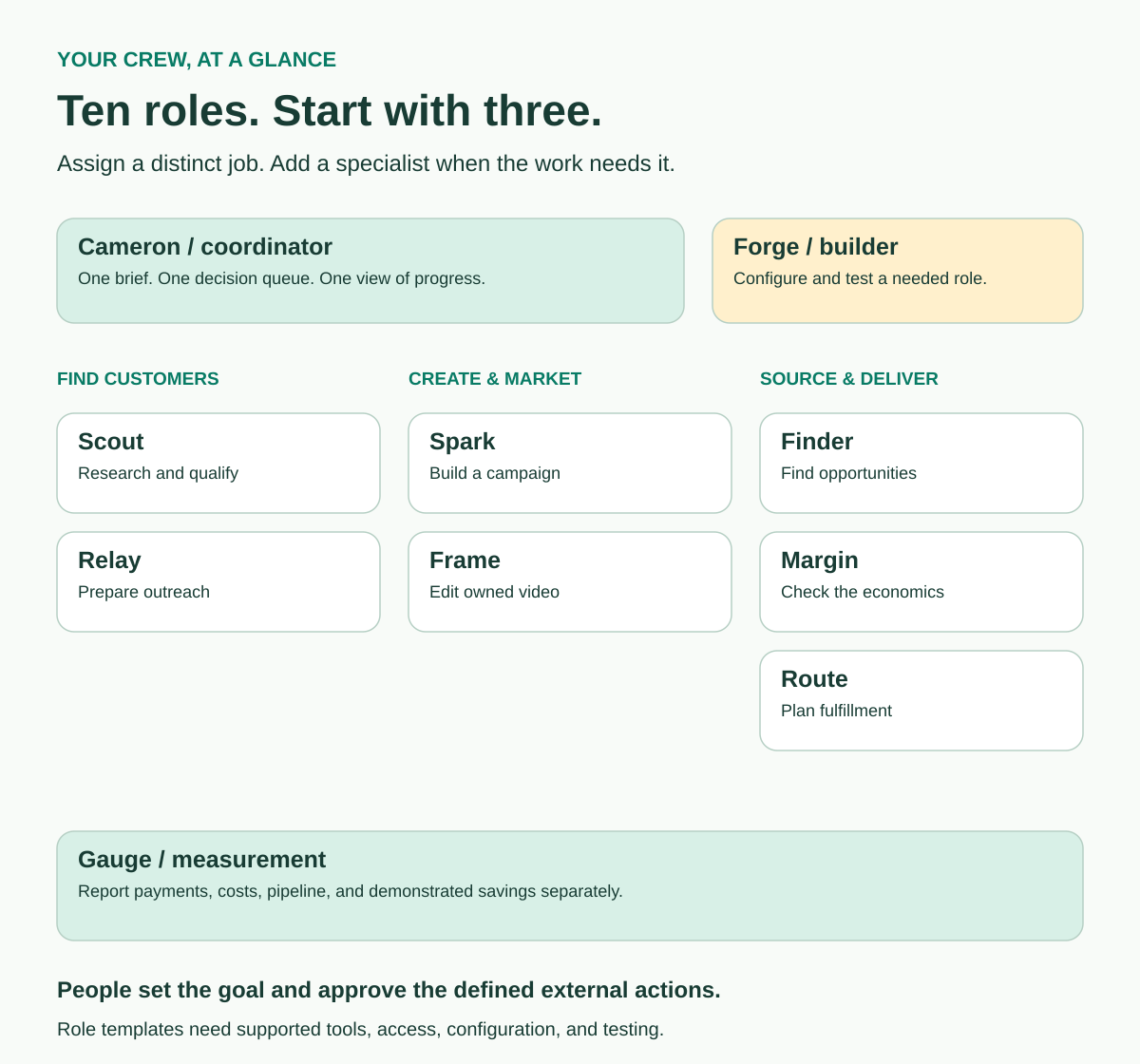
We would build this around ten roles, with a smaller starting team. These are original templates and proposed workflows, not ten agents already running or proven income streams.
Open the detailed reference table
| Agent | Responsibility | A useful first result |
|---|---|---|
| Cameron | Coordinates priorities and review | One decision queue with evidence attached |
| Scout | Finds and qualifies prospects | Five sourced prospects with reasons for fit |
| Relay | Prepares outreach and handles authorized follow-up | Relevant drafts and a clean contact log |
| Spark | Develops offers and campaigns | One coherent campaign ready to review |
| Frame | Repurposes owned video | Two finished clips with checked captions |
| Finder | Finds resale or sourcing opportunities | Candidate items with current availability evidence |
| Margin | Evaluates pricing and unit economics | A conservative margin range with its assumptions |
| Route | Plans fulfillment and delivery | A current quote and a practical handoff plan |
| Gauge | Reconciles results and costs | Cash, pipeline, and savings reported separately |
| Forge | Designs and tests new agent roles | A working role or an honest setup gap report |
Cameron keeps the familiar coordinating role in our Waymaker approach. Forge creates a specialist only when there is a distinct job worth assigning. Gauge replaces the temptation to treat a speculative trading bot as a reliable source of income; an optional market-research workflow stays in paper mode.
Build the lead generation workflow first
Start with one offer and one audience. For example, a service that improves booking conversion could target local service businesses with a publicly observable booking problem. A dated observation about a form or call to action is a useful lead signal. A guess about the owner's revenue is not.
Scout gathers a small sample and checks it against existing contacts, active opportunities, and suppression records. Relay drafts a message that connects the observed issue to a specific, truthful offer. Cameron brings back the sample and the proposed outreach for review. Gauge records replies, qualified opportunities, booked calls, paid work, and costs as separate events.
The quality checkpoint belongs before scale. If five prospects are poorly matched, five hundred will create more cleanup.
For email, verified deliverability does not establish consent or legal eligibility. In the US, commercial email also has requirements around truthful identification, a postal address, and opt-out handling; other jurisdictions and provider rules can be stricter. Build suppression and eligibility checks into the workflow. [12]
Give marketing an outcome beyond “create content”
Spark should start with a single conversion objective: get a qualified booking, sell a verified offer, or earn a relevant signup. It can then prepare the page, email, and supporting content as one connected campaign.
Before release, check the whole experience: does the promise match the offer, does the link lead to the correct destination, does the form work on mobile, and can the business fulfill what it sells? A campaign is not ready merely because the copy sounds polished.
After release, compare the result with a baseline. Track qualified responses and completed transactions. Attribute cautiously when several channels touch the same customer. Count an order once, even if both an email platform and an ad platform claim it.
Measure the work you actually received
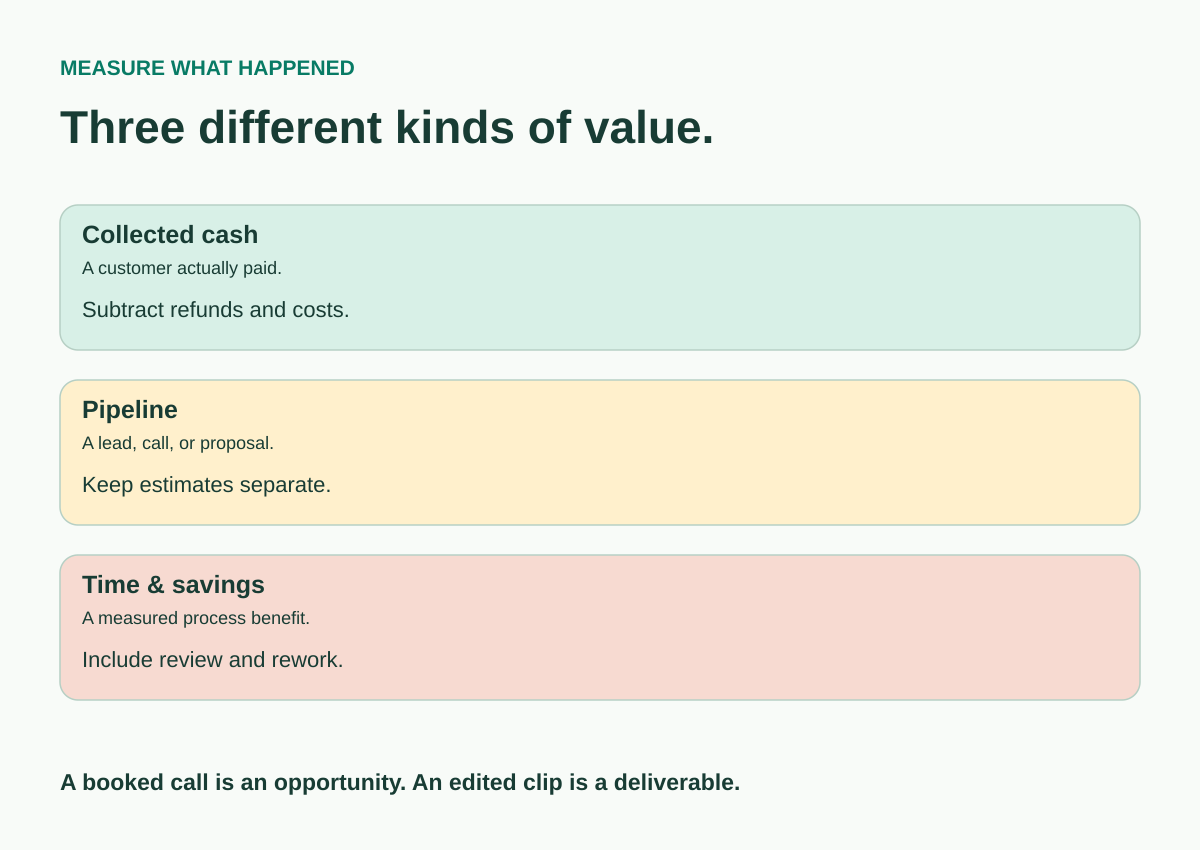
The dashboard should answer four separate questions:
- What cash did customers pay, after refunds?
- What did this work cost, including tools, fulfillment, and human review?
- What opportunities exist but have not paid yet?
- What time or expense was demonstrably saved?
For a resale workflow, a free item still has collection, handling, storage, and selling costs. For a clipping workflow, a usable first edit can be valuable even before it wins a client. For outreach, a booked call is a sales opportunity; it becomes revenue when a customer buys.
Our recommendation is to give one small crew a one-week trial. Establish the baseline, review the first outputs, and improve the instructions where the work breaks down. Expand when it produces a repeatable result worth keeping.
The accompanying AI Work Crew Playbook provides the setup sequence, ten reusable role prompts, lead generation and marketing walkthroughs, test cases, and a shared reporting format. Start with Cameron, Scout, and Spark; add Relay when the outreach process is ready. Build a team around work you can evaluate.
Sources and editorial notes
Editorial inspiration: Rich Holmes's article, Contrarian Thinking's Build Your Grok Bots guide, and the linked Codie Sanchez video. Leadership examples are attributed to Holmes; platform capabilities were checked against the primary documentation below. The AI Work Crew is our proposed operating model, with original templates and workflows ready to test.
- Grok Bot for Linear.
- Codie Sanchez video, reviewed through its timestamped transcript.
- Grok Bot: create and manage bots.
- OpenAI dots: tasks and memory.
- Claude Code: custom subagents.
- Grok Bot: skills and routines.
- ChatGPT Work/Codex: subagents.
- Introducing Claude Duet.
- Claude Code: agent teams.
- Notion Agents.
- Meta Muse.
- FTC: CAN-SPAM business guidance.
Continue with the practical guides
Ready to put this into action? Waymaker helps you go from idea to your first paying customer, with AI doing the heavy lifting alongside you.
Start building free