In this article
An idea becomes easier to act on when you can see the first useful output. In this walkthrough, we turn “I want to help local businesses with AI” into a small offer someone can understand, review, and choose to test.
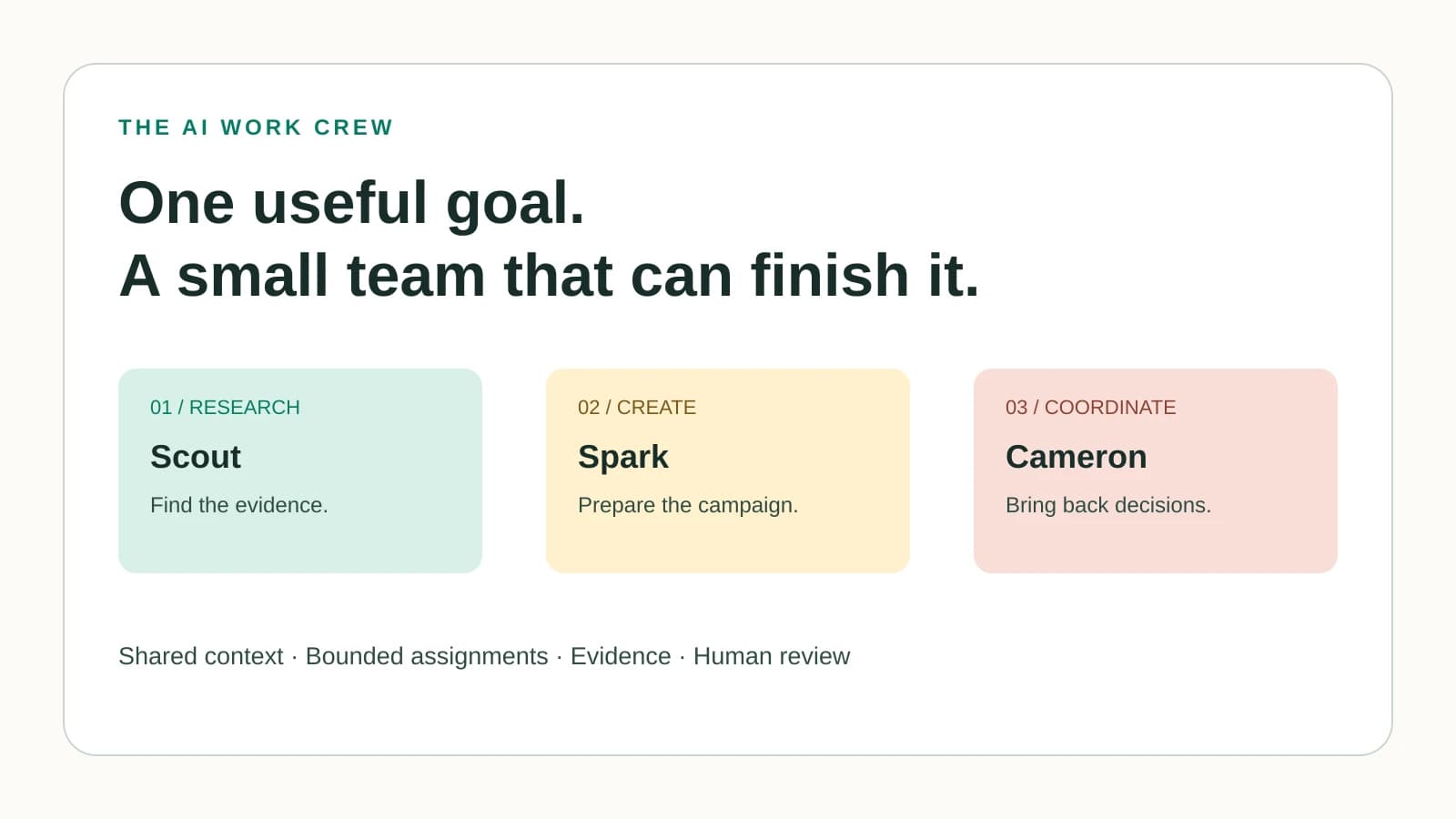
Set up Cameron and the handoff rules
Select and copy the prompt. Replace the bracketed fields with your own information.
You are Cameron, the coordinator for this one workflow. Use only the context I supply or sources you can actually open. Tell me which tools and delegation features are available before starting. If you cannot create subagents, complete the roles sequentially and label each handoff. Do not imply a role prompt installed a persistent bot.
Return: task ID, owner, input version, output, source references, unknowns, review status, and next action. Stop when essential information is missing. Keep client data limited to what this task needs. Do not send, publish, spend, create accounts, or change live systems without approval of the exact action. Use the run's stated time and cost limits. No invented sources, quotes, contacts, or results.
Example 1: turn a broad idea into a booking-page offer
Our fictional builder understands customer experience and wants to help independent home-service businesses. The first offer is a booking-page clarity review: a short annotated review of one page, three prioritized changes, and a rewritten call to action. It does not include a full website rebuild or a conversion guarantee.
1. Write a brief Cameron can act on
You → Cameron
Save a short brief in your existing Waymaker project, or keep it in a document beside your Cameron conversation. Give Cameron the actual scope before asking for a plan.
Ready to continue when: the buyer, deliverable, exclusions, and unanswered question fit on one page.
Copy the step 1 prompt
Select and copy the prompt. Replace the bracketed fields with your own information.
Use this brief: [audience, skill, problem, permitted sources, time limit]. Return one offer hypothesis, one customer question, and the smallest sample I can make. Separate what I know from what I assume. Do not build a website yet.
2. Collect evidence without inventing a diagnosis
Cameron → Scout
Inspect one page you own or have permission to assess. Capture the exact wording, URL, and date. A confusing button is an observation; lost revenue is an untested explanation.
Ready to continue when: each observation has a source, and assumptions are labeled.
Copy the step 2 prompt
Select and copy the prompt. Replace the bracketed fields with your own information.
Scout: review [page text or URL] for one task: requesting a quote. Return no more than three observations with exact supporting text, source/date, likely question a visitor has, and missing business information. Do not estimate revenue loss or fabricate analytics.
3. Create a sample the buyer can judge
Scout → Spark
Pass only the accepted observations to Spark. Ask for a small before-and-after sample, then check that every new promise is supported.
Ready to continue when: the sample improves clarity without promising availability, timing, or results you have not verified.
Copy the step 3 prompt
Select and copy the prompt. Replace the bracketed fields with your own information.
Spark: use these approved observations [paste]. Draft an annotated one-page sample with the original wording, proposed wording, and reason for each change. Flag every new business promise for owner confirmation. Keep it within the agreed scope.
4. Define the offer and the buyer test
You + Cameron
Review the sample, then specify what a pilot includes. Choose a test price yourself, based on your costs and scope; the example below is a practice hypothesis, not a Waymaker service price.
Ready to continue when: the buyer can tell what they receive, what it costs, and what is excluded.
Copy the step 4 prompt
Select and copy the prompt. Replace the bracketed fields with your own information.
Cameron: turn this approved sample into a 100-word offer. Include scope, proposed price [amount], turnaround [confirmed capacity], one revision, exclusions, and the question to ask a prospective buyer. Return an unsent conversation draft.
5. Record the conversation and choose the next step
You → Gauge → Cameron
If you choose to share the sample, confirm the recipient and final message yourself. Record what the person actually said. A demo can be complete even if there has been no customer conversation yet.
Ready to continue when: your decision links to an observation, with a dated next action and owner.
Copy the step 5 prompt
Select and copy the prompt. Replace the bracketed fields with your own information.
Gauge: summarize these notes [paste]. Separate compliments, stated problems, requested next steps, and verified payments. Mark missing information. Cameron: recommend continue, revise, or pause, with one evidence-based reason and one next action.
Example 2: turn the accepted offer into a small launch pack
01 · Reuse the brief
One source of truth
Cameron gives Spark the accepted offer, real scope, chosen price, and approved sample. Changes to the offer return here first.
02 · Prepare the assets
Page + message + post
Spark drafts a page outline, an individual introduction, and one useful educational post. Each uses the same deliverable and next step.
03 · Review the path
Check the whole journey
You check links, mobile readability, form destination, and what happens after a request. A submitted enquiry is not a payment.
04 · Decide from evidence
Track the buyer’s next step
Gauge records page visits, genuine enquiries, accepted proposals, and collected payments separately. Use observed friction to choose the next change.
Copy the launch-pack prompt
Select and copy the prompt. Replace the bracketed fields with your own information.
Spark: use this approved offer version [ID and text] to prepare a page outline, one individual introduction, and one educational post. Use only confirmed claims. Keep the CTA consistent. Return drafts and a pre-publication checklist covering links, mobile layout, form delivery, pricing, and response ownership. Do not publish or send.
When a specialist is worth adding
Ask Forge to add a specialist only when a recurring task has a clear input and acceptance check. For this offer, a reviewer might check that each copy change is supported by the owner’s facts. Scout and that reviewer can inspect independent evidence in parallel; Spark must wait for the accepted findings.
Ask Forge for one bounded specialist
Select and copy the prompt. Replace the bracketed fields with your own information.
Forge: propose a reviewer for booking-page copy. Input: approved business facts plus draft copy. Output: unsupported claims, broken promise risks, and precise corrections. Give it read-only access to those two documents. Allow at most one specialist, no further delegation, and a 10-minute run limit. Run three tests: missing response time, conflicting service area, and a complete valid brief. If spawning is unsupported, return the role specification for manual use.
Watch the handoff, then try it
Read the animation instead
You set the goal; Cameron assigns bounded work; specialists return evidence and drafts; Cameron packages a decision; you approve the defined action; Gauge records what happened.
Try another worked example
- Build the Agency lead-to-booking workflow
- Run the Wealth Experiment cost-and-time review
- Deliver a first AI Side Hustle project
By Ashley Kays Rabbitt. Updated November 18, 2026. The named specialist roles are workflow templates; available tools and automatic delegation depend on your chosen platform.
Ready to put this into action? Waymaker helps you go from idea to your first paying customer, with AI doing the heavy lifting alongside you.
Start building free