In this article
Start with the work you can see clearly
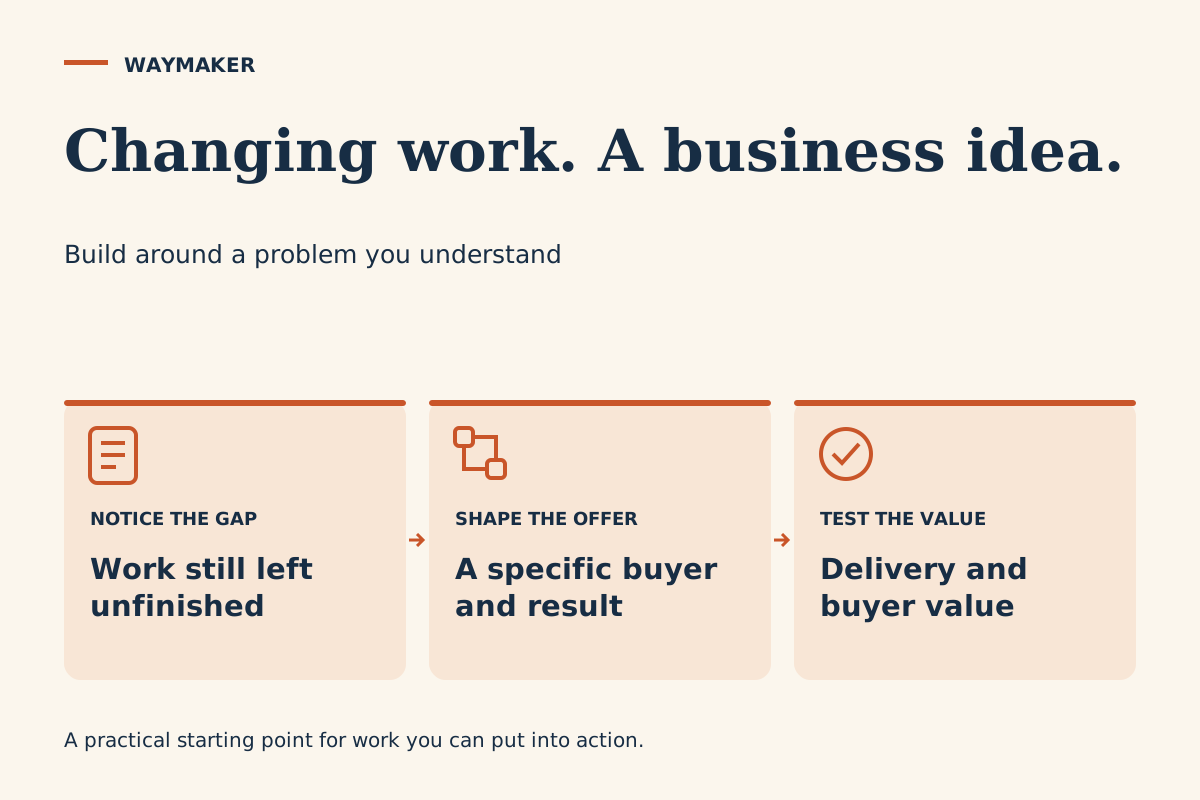
You do not need to predict the next famous AI job title to find a business idea. Pay attention to a task that now starts differently but still needs a dependable finish. A team can generate a proposal quickly and still struggle to make it accurate. A trainer can create materials and still need to help people use them. A founder can build a page and still need to understand why buyers hesitate.
Those gaps are useful places to investigate. Your advantage may be familiarity with the customer, the judgment to assess quality, or the patience to make a process repeatable.
Indeed’s 2024 article prompted this practical look at changing work.
Find the need around the new capability
Draw a line through one task: what happens before the AI runs, what it produces, and what has to happen afterward? Before the task, a customer may need better inputs or a clearer brief. Afterward, they may need verification, editing, integration, training, or follow-through.
Look for work that repeats and has a visible consequence when it goes wrong. Then ask whether the buyer already spends time or money dealing with it. A problem that sounds interesting to you needs a buyer who regards it as important.
Use your own experience as a starting advantage. Someone who has managed client onboarding can recognize an incomplete handoff. Someone who has taught workshops can see when instructions leave a beginner stuck. That familiarity helps you ask sharper questions and build a better first sample.
Your four-step starting plan
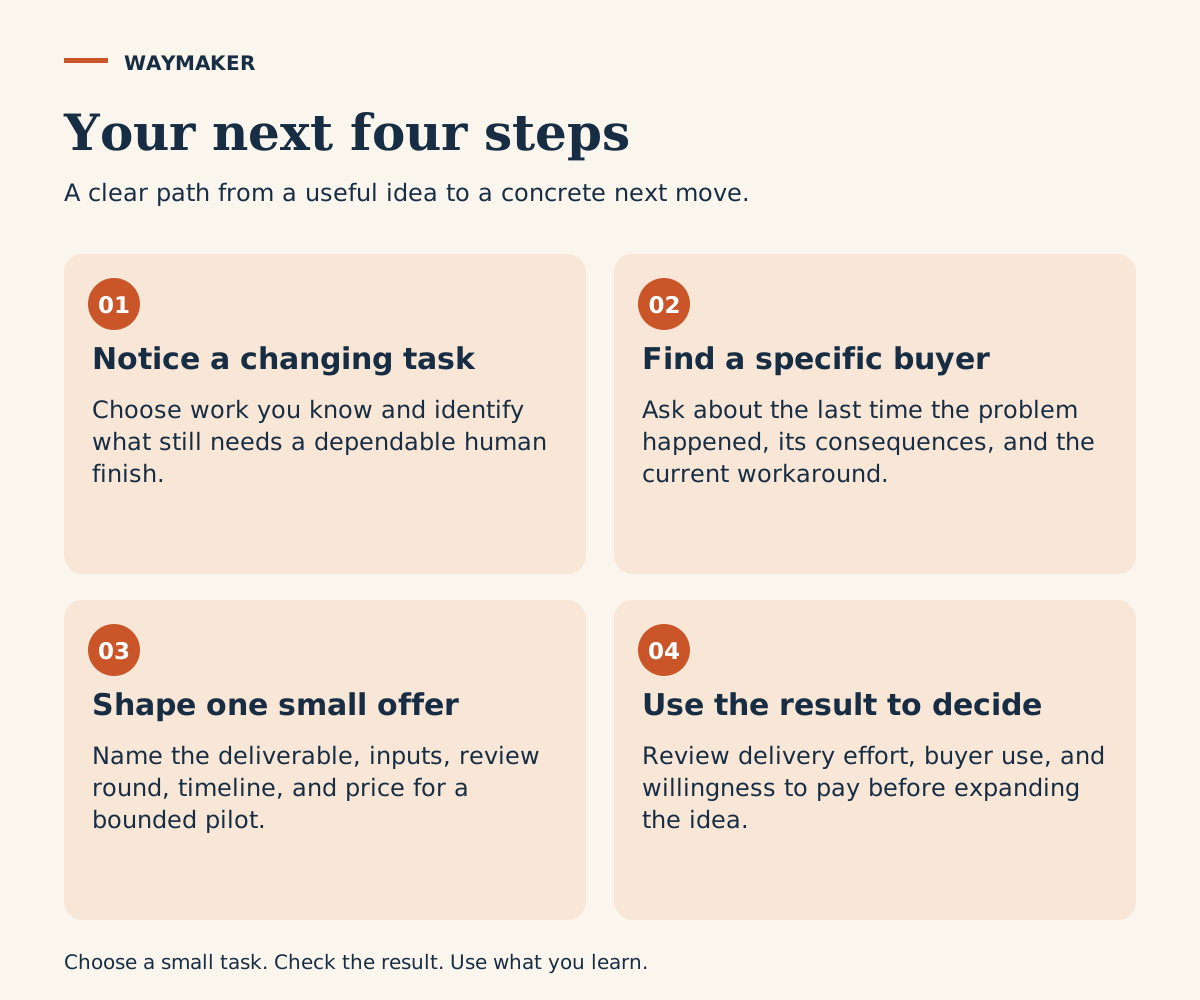
- Notice a changing task
Choose work you know and identify what still needs a dependable human finish.
- Find a specific buyer
Ask about the last time the problem happened, its consequences, and the current workaround.
- Shape one small offer
Name the deliverable, inputs, review round, timeline, and price for a bounded pilot.
- Use the result to decide
Review delivery effort, buyer use, and willingness to pay before expanding the idea.
A worked example: from scattered answers to an onboarding kit
Suppose you have worked with small creative agencies. You notice that new contractors repeatedly ask where to find files, which approvals they need, and how to hand over finished work. The agency already has the answers, but they are spread across messages and old documents.
Your first idea is an onboarding kit assembled from approved source material: a clear first-week guide, a project handoff checklist, and a list of questions the agency still needs to resolve. AI can help organize the material. You decide whether the steps are complete and whether a new person could follow them.
The first version can be a document. Interview three agency owners about the last contractor they onboarded. Ask what went wrong, how they fixed it, and what they would want in the kit. Offer a small paid pilot only after the problem and scope are clear. Deliver one kit for one role and learn from its use before building software around it.
Write an offer someone can picture buying
Use this sentence: 'I help [specific buyer] turn [messy starting point] into [usable deliverable] so they can [next action].' For the agency example: 'I help small creative agencies turn scattered contractor instructions into a first-week onboarding kit their project lead can maintain.'
Then add boundaries: the information the client supplies, the number of deliverables, the review round, the completion date, and what happens after handoff. Those details make the service easier to evaluate and protect your ability to deliver it well.
Set a price only after estimating the full effort, including discovery, corrections, and client communication. Your first goal is a paid learning opportunity with a manageable scope. A polished sales page cannot establish willingness to pay on its own.
Choose evidence that helps you decide what comes next
Before the pilot, write down what you need to learn. Will the owner provide the inputs? Can the deliverable be completed within the agreed scope? Does a new contractor use it without repeated clarification? Would the buyer pay for another version or refer a similar business?
At the end, separate compliments from actions. A person who says the idea sounds useful has given encouragement. A person who commits time, shares approved materials, or pays for a defined outcome has given stronger evidence. Record what happened and what remains uncertain.
You can keep the offer, narrow it, change the buyer, or stop. Each is a valid decision when it follows what you learned. The useful next move is the one that answers the biggest open question without making the project larger than your life can support.
Sources and further reading
Sources reviewed November 11, 2026. The practical examples and service ideas are editorial recommendations, not verified vacancies.
Ready to put this into action? Waymaker helps you go from idea to your first paying customer, with AI doing the heavy lifting alongside you.
Start building free